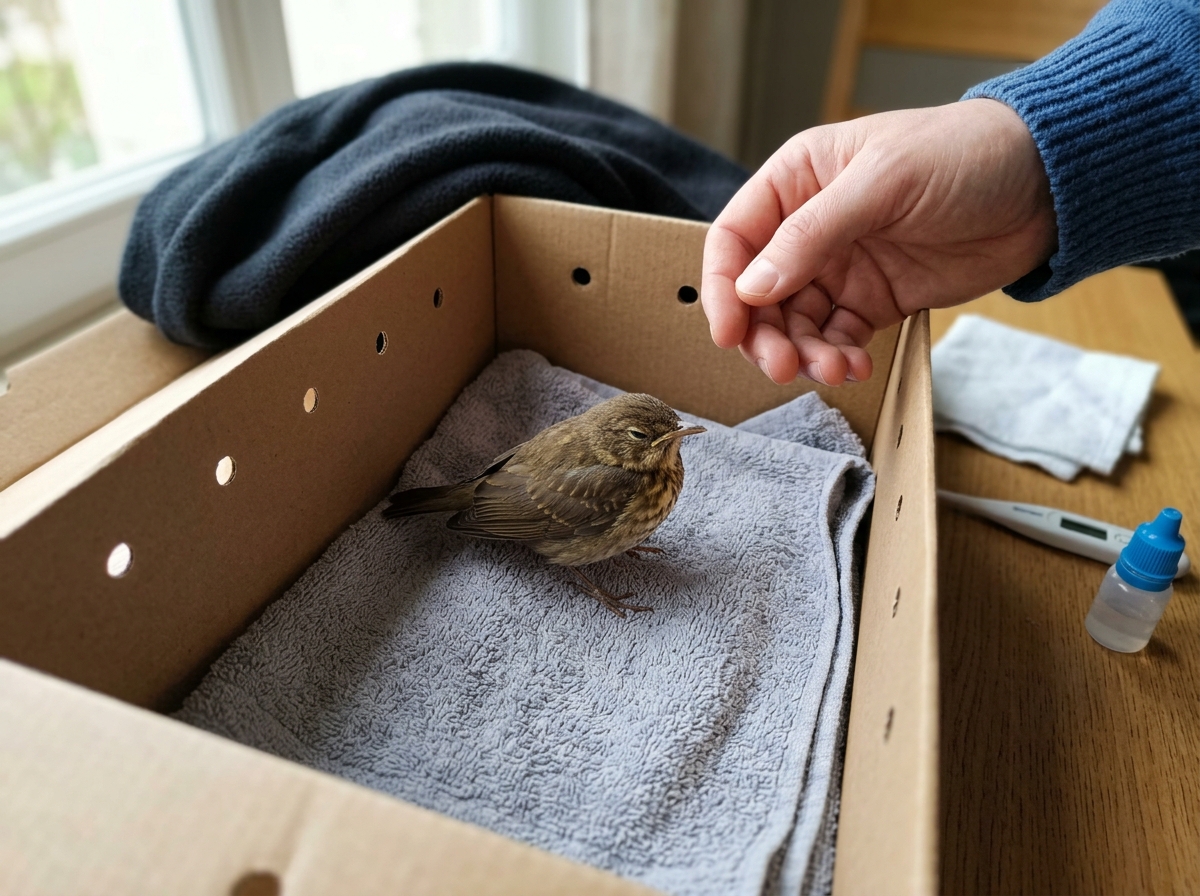
Finding a hurt bird is stressful, especially if you have no idea what to do next. Here's the short answer: keep yourself safe, contain the bird in a dark, quiet box, and contact a wildlife rehabilitator or emergency vet as quickly as possible. That's the core of it. Everything below walks you through the exact steps to take right now, in the right order, so the bird has the best chance of making it.
Hurt Bird: What to Do Now, First Aid and Next Steps
Marcus Chen
23 Mar 2026
Immediate safety and first steps
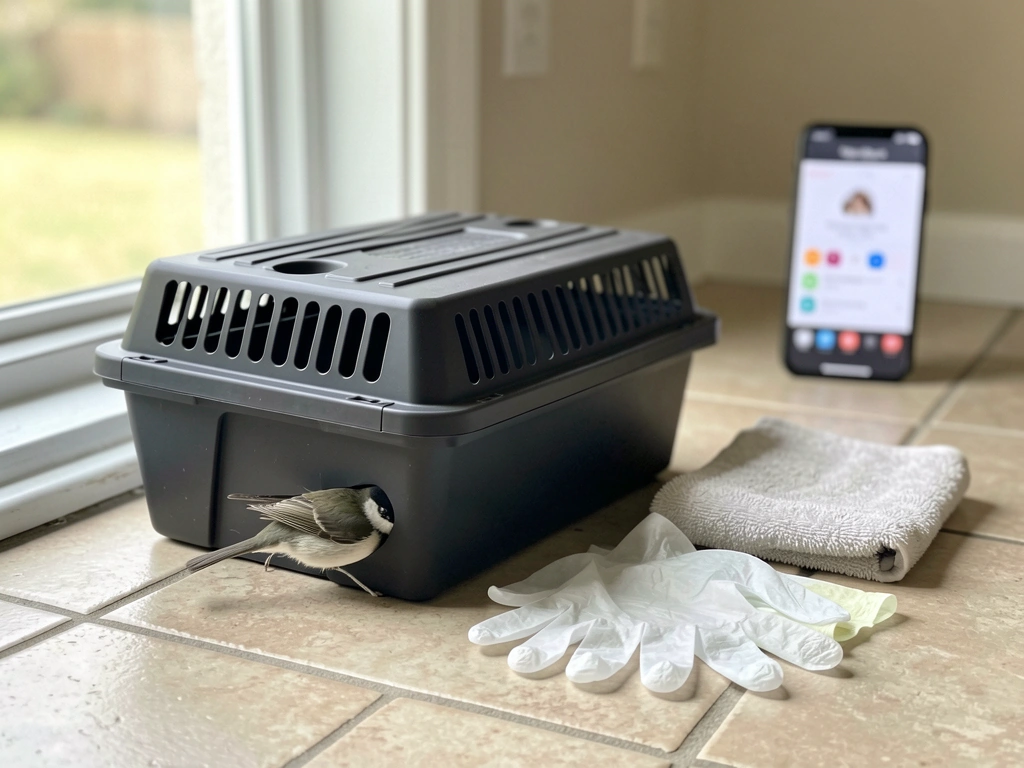
Before you touch the bird, protect yourself. Wild birds can carry bacteria, parasites, and in some regions, avian influenza. Put on disposable gloves before you pick up the bird, full stop. If you don't have gloves, use a folded towel or an inside-out plastic bag over your hands. After handling the bird or anything it touched, wash your hands thoroughly with soap and water, and launder any towels or clothing separately. This isn't about being dramatic, it's just basic hygiene that keeps you safe so you can keep helping.
Once your hands are protected, approach the bird slowly and calmly. Sudden movements spike a bird's stress response, which can make a shock situation worse or even fatal. Crouch down, move in from the side rather than looming overhead, and drape a lightweight towel or cloth over the bird before picking it up. The darkness from the towel almost always calms them immediately. Cup the bird gently but firmly in both hands, keeping its wings against its body so it can't flap and injure itself further.
One important safety note specific to larger birds: herons, raptors (hawks, owls, eagles), and even large waterfowl can cause serious injury. Herons strike at eyes. Raptors have talons that can puncture skin deeply. If you're dealing with a bird of prey or any large wading bird, cover it completely with a thick blanket before attempting to pick it up, and ideally call a wildlife rehabilitator before you touch it at all. Smaller songbirds, pigeons, and doves are generally low-risk to handle with basic gloves.
Quick assessment: is it injured or just grounded?
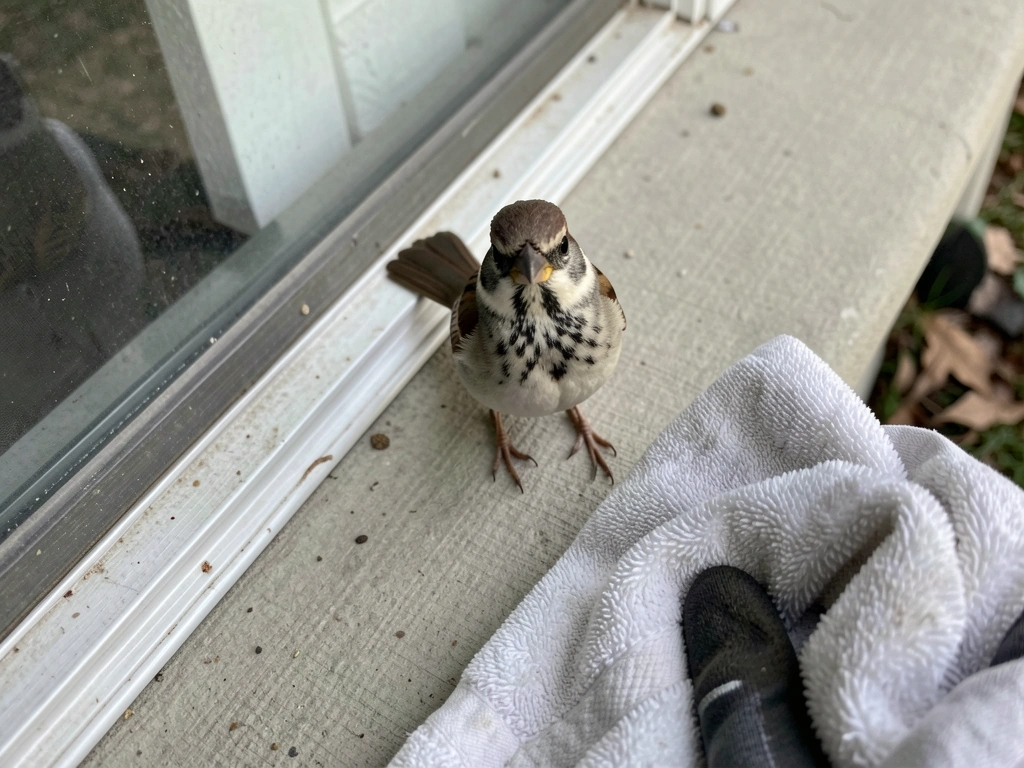
Not every bird you find on the ground needs rescue. This is one of the most important distinctions you can make, because picking up a bird that doesn't need help can actually do more harm than good. Here's how to read the situation quickly.
Signs the bird probably doesn't need your help
- It's a young fledgling (short tail, fluffy patches, hopping around but not flying) — fledglings are supposed to be on the ground while they learn to fly; their parents are usually nearby
- It flew into a window and is sitting stunned but upright, blinking, and gripping a perch or the ground normally — it may recover in 20 to 60 minutes on its own
- It moves away from you when you approach and can sustain short flights
- No visible wounds, blood, or drooping wings
Signs the bird genuinely needs help
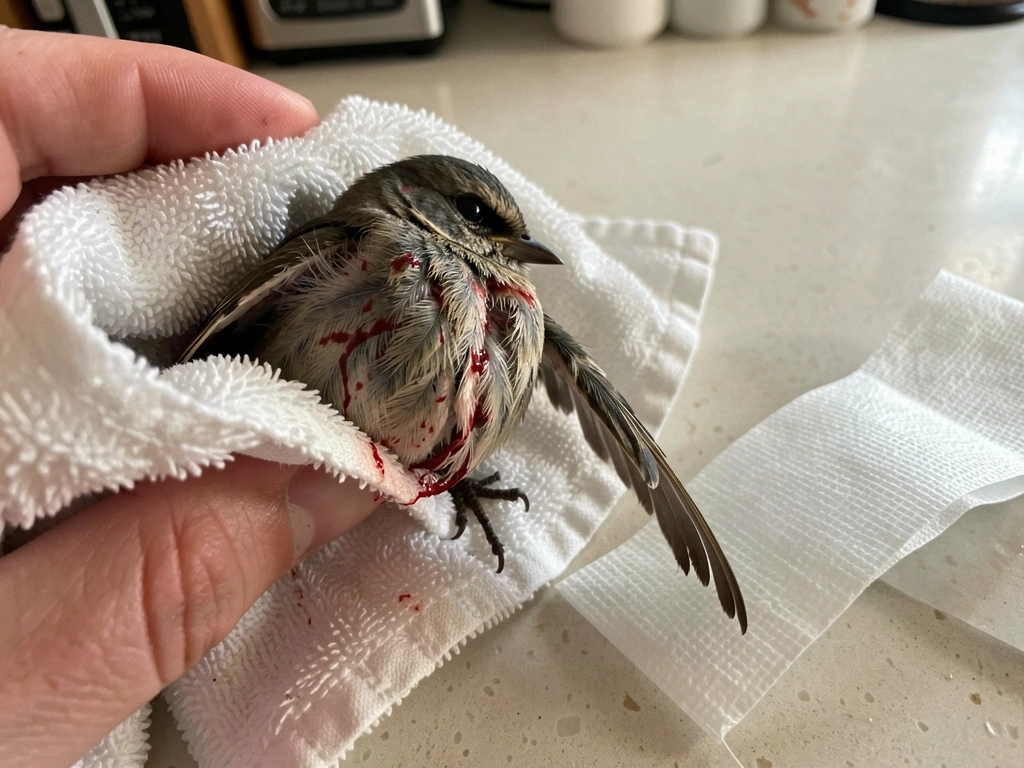
- Visible bleeding, open wounds, or feathers matted with blood
- A wing drooping at an unnatural angle, or a leg hanging limply
- The bird is on its side or cannot hold its head upright
- Eyes closed or half-closed and the bird is non-responsive to your presence
- Labored breathing, open-mouth breathing, or a clicking/wheezing sound
- The bird has been caught by a cat or dog, even if it looks fine externally (cat saliva bacteria are extremely dangerous to birds and require immediate antibiotic treatment)
- The bird is cold to the touch and lethargic
- It's been on the ground in the same spot for more than an hour with no improvement
A bird in shock often looks like it's dying: fluffed feathers, eyes partially closed, unresponsive. Shock by itself is treatable if you act quickly, so don't assume the worst. Get it into a safe container and focus on warmth and quiet first.
First aid basics you can do at home
Let's be honest about what you can and can't do as a non-professional. Your job in the first hour is not to fix the bird. It's to stabilize it, reduce stress, and keep it alive until a professional can take over. That's it, and that's genuinely enough.
Controlling bleeding
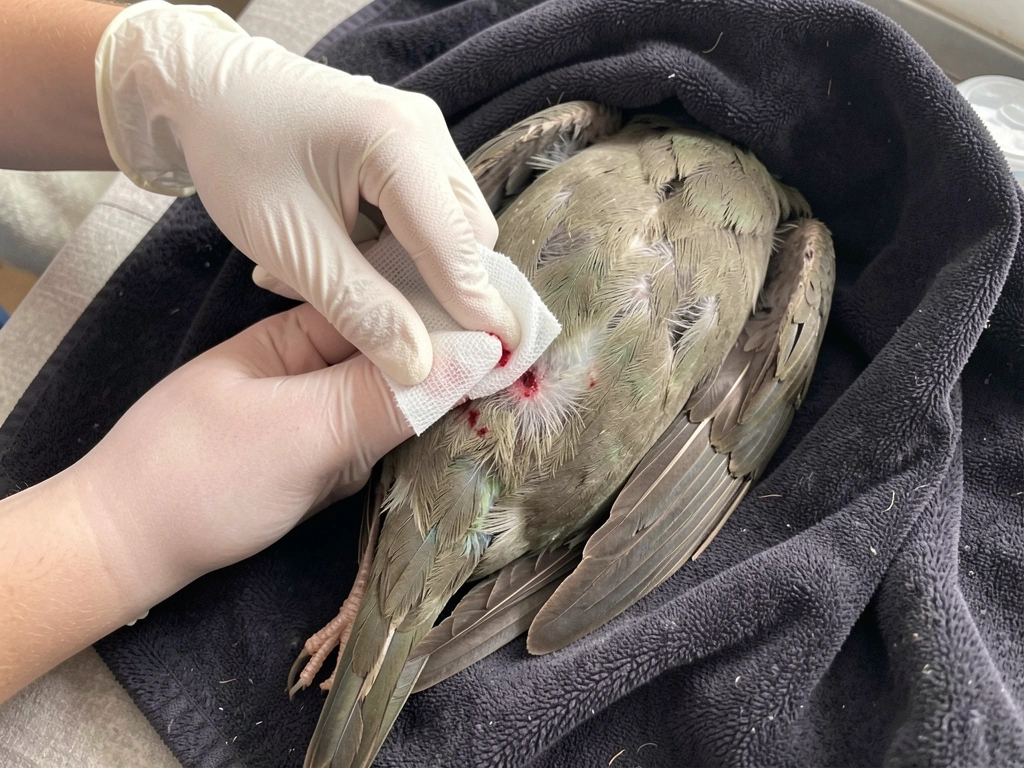
If the bird has an actively bleeding wound, you can apply very gentle pressure with a clean piece of gauze or soft cloth. Hold it in place for two to three minutes without lifting to check. Do not use cotton wool directly on wounds as the fibers can snag in the tissue. If bleeding doesn't slow within a few minutes, that bird needs veterinary care urgently. Do not apply any antiseptic creams, hydrogen peroxide, or household disinfectants to the wound. These damage tissue and can make things significantly worse.
Broken wings or legs
Do not attempt to splint a broken wing or leg yourself. I know it feels like the right thing to do, but improper splinting almost always makes the fracture worse and can cut off circulation. The most useful thing you can do is keep the bird still and in a contained space so it can't thrash and make the injury worse. Place the bird in your box, let a rehabilitator handle the rest.
Food and water
Do not offer food or water unless a wildlife rehabilitator or vet tells you to. This is one of the most common and damaging mistakes people make. A bird in shock or with internal injuries can aspirate water into its lungs, which is fatal. Different bird species also have completely different dietary needs, and feeding the wrong thing can cause serious harm. Keep the bird calm and contained and let the professionals handle nutrition.
Make a temporary recovery setup (warm, dark, low-stress)
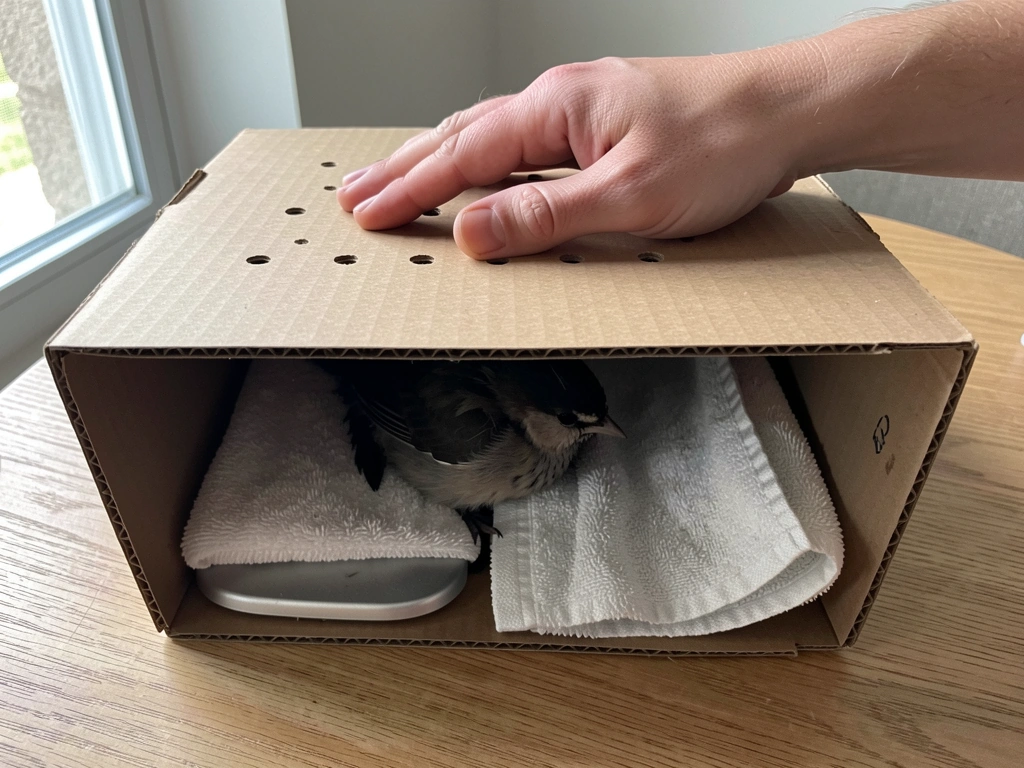
Your goal is a box that feels safe to the bird: dark, quiet, appropriately warm, and escape-proof. Here's how to put one together quickly with things you almost certainly have at home.
- Find a cardboard box or plastic container with a lid. It should be big enough for the bird to stand up in but not so large that it can flap around and injure itself further.
- Punch small air holes in the lid or upper sides, about the diameter of a pencil. A handful of holes is enough.
- Line the bottom with a non-slip surface: a folded paper towel, a piece of fabric, or a hand towel works well. Avoid smooth surfaces like bare cardboard or plastic where the bird's feet can slide.
- Place the bird inside and close the lid. The darkness is calming and mimics how birds naturally rest when they're unwell.
- If the bird is cold to the touch (feel the feet and the skin near the breast), you can add gentle warmth by placing a heating pad set to LOW under one half of the box only, so the bird can move away from the heat if needed. Alternatively, fill a zip-lock bag with warm (not hot) water, wrap it in a cloth, and place it to one side. A temperature of around 85 to 90°F (29 to 32°C) is appropriate for most small birds in shock.
- Put the box in a quiet room away from pets, children, and noise. Don't peek inside repeatedly. Every time you open the box, you're causing a stress response that uses energy the bird desperately needs to recover.
- Do not put the box outside, in a garage with fumes, or in direct sunlight.
Check the box once every 30 to 45 minutes by listening at the outside rather than opening it. If you hear movement or scratching, that's a good sign. Leave it alone and focus on getting expert help lined up.
What NOT to do (common mistakes)
These mistakes happen all the time, usually with the best intentions. Knowing them upfront can save the bird's life.
- Don't give food or water without professional guidance — aspiration and the wrong diet are both potentially fatal
- Don't use human medications, antiseptic sprays, or creams on the bird — ibuprofen, for example, is acutely toxic to birds even in tiny amounts
- Don't keep the bird somewhere noisy, brightly lit, or where it's constantly being watched — chronic stress in birds causes a physiological cascade that can kill even a mildly injured animal
- Don't attempt to splint fractures yourself — you need professional training and the right materials
- Don't leave a cat-attack bird and 'wait to see how it does' — bacteria from cat saliva enter the bloodstream within hours and the bird will die without antibiotics
- Don't place the bird in a wire cage where it can damage feathers and injure itself further while panicking
- Don't assume it needs to be kept forever — wild birds are not pets, and keeping a wild bird without a wildlife rehabilitation license is illegal in most countries, including the US, UK, Canada, and Australia
- Don't force the bird to move, stretch its wings, or test if it can fly — let it rest
When to contact wildlife rehab/vet and how to transport the bird
The honest answer is: contact a wildlife rehabilitator or emergency vet as soon as you've secured the bird in a box. You don't need to wait to see if it 'improves.' Making the call while the bird is resting costs you nothing and can save critical time.
How to find help fast
- In the US: search 'wildlife rehabilitator near me' or call your local animal control or humane society — they maintain lists of licensed rehabilitators; the Wildlife Rehabilitators Directory at wildlifehotline.com is also a useful starting point
- In the UK: the RSPCA (England and Wales), SSPCA (Scotland), and local wildlife rescue centres are your first calls; the RSPCA emergency line is 0300 1234 999
- In Australia: WIRES (NSW), RSPCA Australia, and state wildlife helplines vary by region; Wildlife Victoria: 1300 094 535; WIRES rescue line: 1300 094 737
- Globally: search for your country's wildlife rehabilitation network or contact a local vet who can refer you to the right service
What to tell them when you call
Have this information ready when you call: the species if you know it (or a description of size, color, and markings), where you found it and what you think happened (window strike, cat attack, fallen from nest, etc.), what injuries or symptoms you've observed, and how long the bird has been in your care. The more specific you are, the better guidance you'll get, and the faster they can triage the situation.
Transporting the bird safely
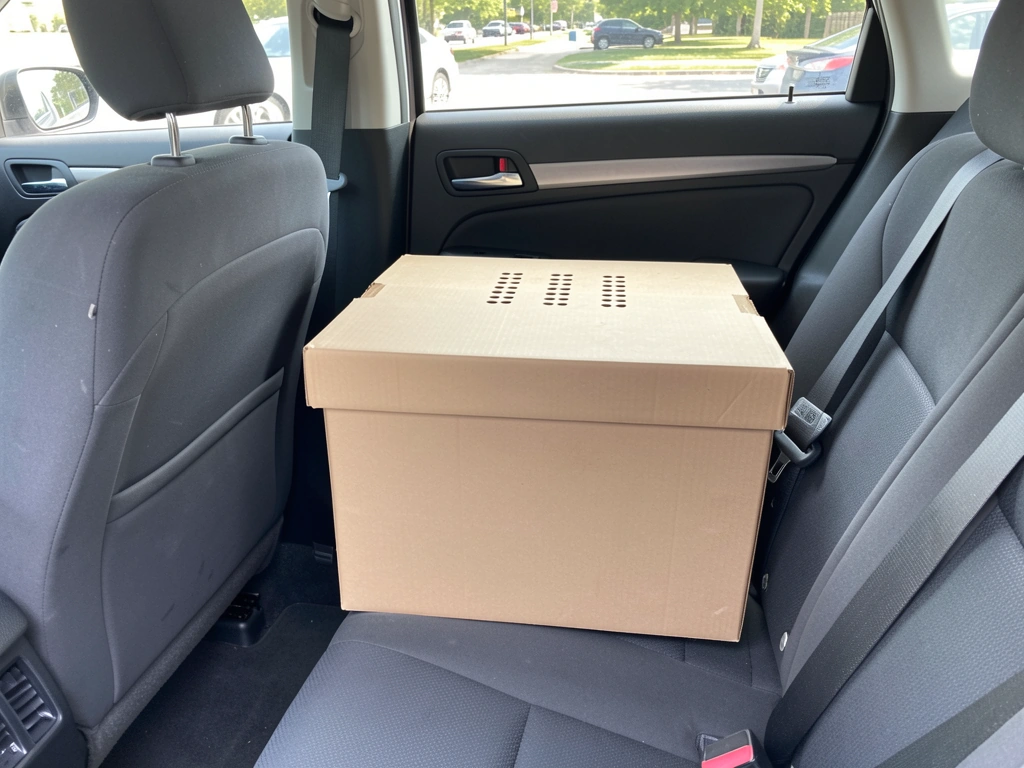
Keep the bird in your dark, ventilated box for transport. Don't open it during the drive. Place the box on the seat beside you or on the floor where it won't slide or tip, and secure it so it stays stable around corners. Keep the car quiet, minimize air conditioning or heating blasting directly at the box, and drive as smoothly as possible. A 20-minute car ride in a dark, stable box is far less stressful than most people expect, and it won't set back the bird's recovery.
Follow-up: recovery expectations and release-ready guidance
Once the bird is with a licensed rehabilitator or vet, your role shifts to patient supporter rather than caretaker. Here's what to realistically expect depending on the type of injury.
| Situation | Likely outcome | Typical timeline |
|---|---|---|
| Window strike with no visible injury | Full recovery likely if it survives the first few hours | Hours to 1 day |
| Cat or dog attack (any severity) | Requires antibiotics; outcome varies by severity of internal injury | Days to weeks of rehab |
| Broken wing (clean fracture) | May heal well with proper splinting; flighted release possible | 4 to 8 weeks of rehab |
| Broken wing (shattered or joint damage) | May not regain flight; could become a permanent education bird | Long-term or permanent |
| Shock with no other injury | High recovery rate with warmth, quiet, and fluids from a vet | Hours to days |
| Severe head trauma | Unpredictable; some birds recover fully, others do not | Days to weeks; uncertain |
| Fledgling separated from parents | High success rate if parents can be reunited; else raised in rehab | Weeks to months |
A good wildlife rehabilitator will give you an honest prognosis and, in many cases, let you know when the bird has been released back into the wild. Some facilities post updates or allow follow-up calls. It's completely reasonable to ask for an update when you drop the bird off.
The goal for any wild bird is always return to the wild. Release is considered when the bird can fly strongly, forage independently, shows normal fear of humans, and has no injuries that would prevent survival. This standard exists for the bird's welfare, not as a bureaucratic hurdle. A bird that can't meet these criteria isn't released, not because rehabilitators give up, but because releasing a bird that can't survive would be cruel.
If the worst happens and the bird doesn't make it, know that you did the right thing. Getting it off the ground, into warmth and quiet, and to professional hands gave it every chance it had. That matters, even when the outcome isn't the one you hoped for.
Your quick-action checklist
- Put on gloves or use a towel before touching the bird
- Approach slowly; cover the bird with a cloth before picking it up
- Assess quickly: is it truly injured, or just stunned or a fledgling?
- Place it in a dark, ventilated cardboard box lined with paper towels or a soft cloth
- Add gentle warmth on one side only if the bird feels cold
- Put the box somewhere quiet and leave it alone
- Call a wildlife rehabilitator or emergency vet immediately
- Do NOT give food, water, or any medication
- Transport in the closed box; keep the drive calm and smooth
- Wash your hands and launder anything that touched the bird
FAQ
What if the bird is still moving but not fully responsive, should I wait before contacting help?
No. Even if the bird seems “not that bad,” shock and internal injuries can worsen quickly. Arrange transport and contact a wildlife rehabilitator or emergency vet as soon as the bird is contained, and tell them how long it has been in your care.
How warm is “warm enough” during recovery, and how can I tell the bird is overheating?
Use gentle, ambient warmth, not heat blasting directly on the bird. Overheating signs include panting, very rapid breathing, or the bird feeling hot to the touch through the container. If you feel heat is too strong, reduce the heat source and get guidance from the rehabilitator.
Should I cover the box with a blanket to keep it dark, or does the bird need airflow?
Darkness helps calm the bird, but it still needs ventilation. Ensure the container has airflow gaps and do not fully seal it. If you add a blanket, keep it breathable around the sides and avoid blocking all air movement.
What should I do if the bird is wet (rain or spilled water) or covered in oil?
Keep it in a dark, quiet container, minimize handling, and contact a professional immediately because oil and heavy wetness can affect insulation and breathing. Avoid cleaning with household soaps or solvents, since residue and cold shock can worsen the bird’s condition.
Can I use a carrier or laundry basket instead of the “dark box,” and what matters most?
Yes if it is escape-proof, stable, and mostly dark, but prioritize safety features. The key is preventing flapping and escape, having some ventilation, and using a surface that reduces sliding during transport. Avoid open containers or ones with mesh that could tangle claws or wings.
The bird has a small cut, should I disinfect it or apply something for infection?
Do not apply antiseptic creams, hydrogen peroxide, or household disinfectants. For small bleeding, use gentle pressure with clean gauze or soft cloth for a couple of minutes, then seek urgent vet or rehabilitator care if bleeding does not slow.
What if the bleeding stops but the bird still looks stunned or fluffed up?
That still counts as a rescue situation. Shock can present even when external bleeding is minimal, so keep warmth and quiet, do not feed or water, and contact a professional promptly.
What if I suspect a window strike and the bird seems okay after a few minutes?
Do not treat it as fully fine just because it “recovers” briefly. Concussion and internal injuries may not be obvious. Contain it, keep it calm and warm, and contact a wildlife rehabilitator or emergency vet, especially if it seems disoriented or has trouble staying upright.
Should I try to place the bird back outside where I found it if it seems to regain strength?
Usually no. Temporary improvement can be misleading, and release should only be decided by a professional based on the bird’s ability to fly, forage, and survive without further injury. Keep it contained until the rehabilitator or vet gives instructions.
If I find a nestling or fledgling on the ground, do the same rules apply?
Containment and minimizing handling still apply, but the “does it need rescue” decision differs for juveniles. If it is a baby bird that cannot stand or beg properly, or seems displaced from its nest, contact a wildlife rehabilitator right away. Avoid feeding unless a professional directs you.
What should I do after I handle the bird, can I touch my phone, pets, or kitchen surfaces?
Limit contact with other surfaces. After handling, remove gloves if used, wash hands thoroughly with soap and water, and launder any towels or clothing separately. Keep pets away until you have finished cleanup to reduce spread of parasites or bacteria.
How do I choose between an emergency vet and a wildlife rehabilitator?
If the bird is bleeding heavily, appears unable to move normally, is a raptor or large wading bird, or you cannot reach a rehabilitator quickly, an emergency vet may be the fastest option. If it is after-hours and you can reach an emergency provider sooner, go with the fastest medically appropriate care.
Is it safe to cover the bird and place it in a warm room overnight while I wait for a morning call?
Do not delay professional contact unnecessarily. If you truly cannot reach help overnight, keep the bird in the dark, quiet, ventilated container with gentle warmth and do not feed or give water, but still call as soon as lines open and follow any instructions they provide.
What information should I provide to the rehabilitator if I cannot identify the species?
Describe size and features clearly, include color patterns, approximate weight (or whether it is smaller than a sparrow or pigeon), and any visible injuries (eye injury, bleeding, wing droop, lethargy). Also share circumstances like cat attack, window strike, or falling from a height, and how long it has been in your care.
Next Article
Will a Bird Broken Leg Heal on Its Own? What to Do Now
Broken bird leg usually won’t heal safely on its own; learn signs, first aid, and when to get vet or wildlife help.